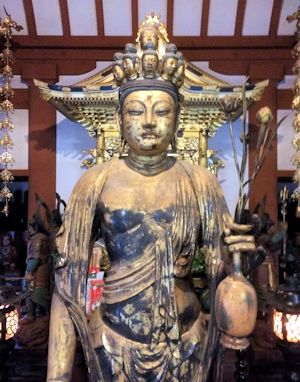
明治維新になって、政府の廃仏毀釈(仏を廃し神を敬する)の令きびしく、大神神社の神宮寺であった平等寺は、ことさらにそのあらしを強く受け、有名な金屋の石仏をはじめ61体にのぼる仏像が他所に運び出され、堂塔ことごとく整理を迫られましたが、覚信和尚や町内有志の方々の努力により塔頭の一部を境内に移し、本尊秘仏十一面観世音菩薩、三輪不動尊、慶円上人像、仏足石等が守られ、梁天和尚が翠松庵の寺号を移し禅曹洞宗に改宗し法燈を護持しました。
Preserving the Sacred Flame Through the Persecution of the Meiji RestorationWith
the advent of the Meiji Restoration, the new government strictly enforced
the Haibutsu Kishaku policy—a movement aimed at abolishing Buddhism to
elevate Shinto. Serving historically as the Jinguji (the shrine-integrated
temple) of Omiwa Shrine, Byodo-ji bore the full, merciless brunt of this
ideological storm.The temple was forced into immediate dismantling, and
its historic structures were entirely cleared away. Sixty-one sacred Buddhist
statues, including the famous Kanaya Stone Buddha, were hastily removed
and sent to other locations.Yet, even in the depths of this crisis, the
flame of faith refused to be extinguished. Through the heroic and tireless
efforts of Priest Kakushin alongside 18 dedicated local volunteers, parts
of the temple's sub-structures (tachu) were physically relocated within
the current precincts. This defensive action successfully protected and
preserved the temple's most sacred treasures: the hidden principal image
of the Eleven-Headed Kanzeon Bodhisattva, the Miwa Fudo Myoo, the statue
of the restorer Keien Shonin, and the Buddha’s Footprint Stone.Shortly
thereafter, Priest Ryōten transferred the temple name "Suisho-an"
to this resilient sanctuary, converted its lineage to the Soto Zen sect,
and proudly kept the sacred light of the Buddhist teachings alive for generations
to come.
三輪山伝説
開基開山は聖徳太子
平等寺の開基開山は聖徳太子と伝えられています。聖徳太子の父である第31代天皇の用明天皇は「天皇は仏法を信じ神道を尊ぶ」とみことのりを出されました。仏法を信じるとは仏の教えを信じ実行すること、神道を尊ぶとは神の道を尊び敬いの心を大切に生きることであります。用明天皇の第二子である聖徳太子は、幼少期から非常に聡明で仏法をあつく敬ったそうです。まだ幼い聖徳太子が、戦が絶えなかった時代に、なんとかこの国を平和な国にしていただきたいということで三輪明神に来られて、この願いがかなえば必ずここに十一面の観音を刻んでおまつりいたしますという請願を立てられました。それをきっかけとして建てられたのが平等寺と伝えられます。
聖徳太子とお供の方、賊軍の大将綾葛が、太子に帰依している大変珍しいお像です。明治の廃仏毀釈で一度失われましたが、1982(昭和57)年本堂再建の折に三輪の奥山家より還ってきました。
The Founding of Byodo-ji and the Legend of Prince Shotoku
According to legend, Byodo-ji Temple was founded by Prince Shotoku. His
father, Emperor Yomei (the 31st Emperor of Japan), once issued an imperial
decree stating that "The Emperor shall believe in the Buddhist Dharma
and revere the Shinto Way." To believe in the Dharma meant to trust
and practice the teachings of the Buddha, while to revere the Shinto Way
meant to live with a deep sense of respect and honor for the native deities.Prince
Shotoku, the second son of Emperor Yomei, was exceptionally brilliant from
early childhood and held a profound devotion to Buddhism. During an era
of endless warfare, the young prince visited the Great Deity of Miwa (Miwa
Myojin) to pray for lasting national peace. He made a solemn vow: "If
my prayers for peace are granted, I will carve a statue of the Eleven-Headed
Kannon Bodhisattva and enshrine it here forever." It is said that
this historic vow led to the creation of Byodo-ji Temple.The unique statue
group preserved at the temple depicts Prince Shotoku, his attendants, and
Ayazura—the defeated general of a rebel army who eventually surrendered
and became a deeply devoted follower of the Prince. Although this rare
masterpiece was lost during the anti-Buddhist movement (Haibutsu Kishaku)
of the Meiji Restoration, it was safely protected for generations by the
local Okuyama family of Miwa and was miraculously returned to the temple
when the Main Hall was rebuilt in 1982.
中興の祖、慶円上人は三輪明神と問答された
三輪山平等寺の開山は、聖徳太子と伝えられますが、中興の祖は慶円常観上人で、三輪上人ともいわれます。『大三輪町史』には次のように記されています。「慶円は、保延6年(1140)鎮西(九州)に生まれた。吉野の堯仁に師事して、醍醐金剛王流(真言宗)の奥義をきわめる。のち、安倍の崇敬寺に住み、三輪山平等寺にうつった。日々、三輪山で秘法を修めていたが、ある日、閼伽井(アカイ)のほとりで、三輪明神の影向(ヨウコウ)をうけ、神道灌頂之秘法(シンドウカンジョウノヒホウ)を授けられた。貞応2年(1223)1月27日、84歳で示寂した」
慶円さまは1140年にお生まれになりましたが、その時すでに眉間に琥珀色の肉が出ていて、お釈迦さまの白毫大丈夫の相のようであったと伝えられています。
成人して自ら「三界は元より空なり、萬法は幻の如し、栄華の世相なんぞ常に保つべけんや」といわれたそうです。
和州(奈良)の吉野の堯仁阿闍梨について修行し、竜門寺において写経修学(大般若経、華厳経、その他)され、室生山では一千日の参篭をされ、即身成仏の玄義を学び、夢に善竜女に会い、菩提心を得、舎利をまつられました。そして、安倍寺で修行を重ね、三輪山遍照院にうつられ、1204年、差別のない平等の世の中を願求して『三輪山平等寺』と改号されたのです。1207(承元元)年には、後鳥羽上皇の臨幸を仰いで、大野寺弥勒磨崖仏の地鎮を行いました。慶円さまは、生まれつき慈悲の心あつく、すべての人を救う神仏のような思いをおもちのお方でありました。
まだ夜もあけぬ朝、平等寺のみ仏にお供えするあかいの渓水を汲みにいかれた時、三輪明神が貴女の姿になって石上にあらわれ、慶円さまと問答をなさるのです。慶円さまが「あなたさまのお名前をおきかせ下さい」と尋ねると、貴女は、「この山の杉です」とお答えになり、自ら「おのづから いわきをおのが すがたにて かげはずかしき みむろやまかな」と詠ぜられ、御身を消されたといわれます。
この31文字の和歌が平等寺のご詠歌として伝えられております。
作家の山路麻芸氏は「三輪明神にゆかりのある場所 平等寺」で次のように述べられています。「慶円が、三輪明神より授けられた神道の秘法とは、三輪流神道と呼ばれるものである。(中略)三輪流神道は、大神神社で古くから唱えられたもので、真言密教の教理、儀式と、陰陽(オンミョウ)五行の理にもとづいて『日本書紀』の神代の巻を解釈した両部神道の一派のことである。両部神道は本地垂迹説(ホンジスイジャクセツ)の根底をなすもので、本地である印度の仏や菩薩が、衆生済度のために神に姿をかえたという神仏同体説である。即ち、宇宙の根本原理が、印度では仏、日本では神として現れたという、仏教と神道との妥協である。本地は大日如来であるが、天上界では天照大神としてあらわれ、大和三輪山では大神大明神となり、伊勢では皇太神となるという、まことに融通無碍な教えである。しかし、明治以後、神仏混淆の禁止により、おとろえたとのことである。」
慶円さまは、仏教各宗のご開山と同格に、わが国最初の仏教史書「元亨釈書」(ゲンコウシャクショ)に出ている高僧で、そのご一代が明らかであります。三輪山平等寺中興の祖として、また三輪流神道の祖として、正法の興隆につくされた慶円さまは、1223年正月27日遷化され、84歳の尊いご一代に幕をおとされました。
The Restorer and Founder: The Venerable Monk Keien Zenkan Daiwajo (Heian
to Kamakura Period)
The Life and Training of the Venerable KeienWhile Byodo-ji Temple is traditionally
said to have been founded by Prince Shotoku, its restorer was the Venerable
Keien Zenkan Daiwajo, also known as Miwa Shonin. The History of Omiwa Town
(Dai-Miwa Choshi) records his life as follows:"Keien was born in Chinzei
(Kyushu) in 1140 (Hoen 6). He studied under Jōnin of Yoshino, mastering
the deepest secrets of the Daigo Kongo-o lineage of Shingon Buddhism. He
later resided at Sukei-ji Temple in Abe before moving to Byodo-ji Temple
on Mount Miwa. While performing esoteric rituals daily on Mount Miwa, the
Miwa Deity appeared to him by the Akai (sacred well) and bestowed upon
him the secret ritual of Shinto Initiation (Shinto Kanjo). He passed away
on January 27, 1223, at the age of 84."Legend states that at the moment
of Keien's birth in 1140, a distinctive amber-colored mark was already
visible between his eyebrows, resembling the Byakugo (the white urna on
the forehead of Shakyamuni Buddha, which signifies great wisdom). Upon
reaching adulthood, he is said to have declared: "The three realms
of existence are originally empty, and all phenomena are like illusions.
How can the fleeting glories of this mundane world ever endure?"He
underwent rigorous spiritual training under Jōnin Ajari in Yoshino (Yamato
Province/modern Nara). At Ryumon-ji Temple, he dedicated himself to copying
and studying sacred texts, including the Great Perfection of Wisdom Sutra
(Dai-Hannya Kyo) and the Avatamsaka Sutra (Kegon Kyo). He then entered
a 1,000-day period of secluded meditation on Mount Muro, where he mastered
the profound mysteries of attaining Buddhahood in this very body (Sokushin
Jobutsu). During this time, it is said that a benign dragon goddess appeared
to him in a dream, through which he attained the Bodhi-mind (the aspiration
for enlightenment) and enshrined sacred Buddha relics.Following further
training at Abe-dera Temple, he relocated to the Henjo-in sub-temple on
Mount Miwa. In 1204, driven by a profound vow to create a world of absolute
equality free from all discrimination, he officially changed the temple’s
name to Miwa-san Byodo-ji (The Temple of Equality on Mount Miwa). In 1207
(Jogen 1), under the imperial presence of Retired Emperor Go-Toba, Keien
performed the sacred ground-purification ritual for the famous Miroku Magaibutsu
(the cliff-carved Maitreya Buddha) at Ono-ji Temple.The Divine Encounter
and the Sacred HymnKeien possessed a naturally compassionate heart, filled
with a divine desire to save all living beings. One morning before dawn,
as he walked to gather Akai (sacred valley water) to offer to the temple's
Buddhist deities, the Miwa Deity appeared atop a sacred rock, manifesting
in the form of a noble woman to engage in a spiritual dialogue with him.When
Keien inquired, "May I humbly ask your divine name?" the noble
woman replied, "I am the cedar tree of this mountain." She then
composed and recited a 31-syllable tanka poem:"Naturally manifesting
itself in the forms of rocks and trees, the shadow of the sacred Mount
Mimoro reveals its divine presence with a sense of pure humility."Immediately
after speaking these words, her physical form vanished into the air. This
historic 31-syllable poem has been carefully passed down through generations
as the official Go-eika (sacred pilgrim hymn) of Byodo-ji Temple.Understanding
Miwa-ryu ShintoIn her work Byodo-ji: A Place Connected to the Miwa Deity,
author Magei Yamaji provides the following insight into Keien's legacy:"The
secret Shinto rituals bestowed upon Keien by the Miwa Deity became known
as Miwa-ryu Shinto (Miwa-style Shinto)... This tradition had been practiced
since ancient times at Omiwa Shrine. It represents a branch of Ryobu Shinto
(Dual Shinto), which interprets the divine ages of the Chronicles of Japan
(Nihon Shoki) based on the doctrines and rituals of Shingon Esoteric Buddhism,
combined with the principles of Yin-Yang and the Five Elements. Ryobu Shinto
forms the foundation of the Honji Suijaku theory (manifestation from the
original ground)—a concept of Shinto-Buddhist unity positing that the original
Buddhas and Bodhisattvas of India changed their forms into native Japanese
deities (Kami) to save sentient beings. In essence, it is a harmonious
reconciliation between Buddhism and Shinto, teaching that the fundamental
principle of the universe manifests as a Buddha in India and as a Kami
in Japan. Under this fluid and unhindered doctrine, the ultimate source
is Dainichi Nyorai (the Cosmic Buddha), who manifests as Amaterasu Omikami
in the heavenly realm, as the Great Deity of Miwa on Mount Miwa in Yamato,
and as Kotai Jingu in Ise. However, following the Meiji era's strict prohibition
of the syncretism of Shinto and Buddhism, this teaching unfortunately declined."Legacy
and PassingThe Venerable Keien’s extraordinary achievements are chronicled
in the Genko Shakusho, Japan's oldest official history of Buddhism. In
this text, his life is detailed with the same high prestige and status
afforded to the primary founders of Japan’s major Buddhist sects, making
his historical timeline exceptionally clear. Dedicating his entire life
to the revival and prosperity of the True Dharma (Shobo) as the restorer
of Miwa-san Byodo-ji and the father of Miwa-ryu Shinto, Keien passed away
on January 27, 1223, bringing a close to his deeply revered and sacred
84-year life.
本尊は十一面観音様か阿弥陀如来様か
寛文、延宝(1661~1681)の頃の島津綱貴の書翰には当時の平等寺の全貌が記されており、その覚書の最初には「一、平等寺本堂 六間四面 屋根瓦葺 本尊 十一面観音秘仏聖徳太子御自作」と記されています。また、1771(明和8)年5月の三輪山平等寺の御朱印には中心に「本尊阿弥陀如来 三輪山平等寺」と書かれており、さらに1808(文化5)年に伊能忠敬が奈良を測量したあとに寺社を参詣し宝物を拝観した記録には「三輪山平等寺 眞言宗 開基聖徳太子 中興開山慶圓上人 本堂 六間四面 本尊 阿弥陀 安阿弥作」と記されています。
Historical Records of the Principal Image in the Edo Period
A historical letter written by the lord Tsunataka Shimazu during the Kanbun
and Enpo eras (1661–1681) provides a comprehensive description of Byodo-ji
Temple at the time. The very first line of his memorandum clearly states:
"Item: Byodo-ji Main Hall, measuring six ken (approx. 11 meters) on
all four sides with a tiled roof. The principal image is the secret Buddha,
the Eleven-Headed Kannon, hand-carved by Prince Shotoku."Interestingly,
an official vermilion-seal document (Goshuin) from Miwa-san Byodo-ji dated
May 1771 displays the inscription "Principal Image: Amida Nyorai,
Miwa-san Byodo-ji" at its center.Furthermore, in 1808 (Bunka 5), the
famous cartographer Tadataka Ino, after surveying the Nara region, visited
local temples and shrines to view their sacred treasures. His logs record:
"Miwa-san Byodo-ji Temple, Shingon Sect. Founded by Prince Shotoku,
restored by Keien Shonin. Main Hall measures six ken on all four sides.
Principal image: Amida, crafted by An'ami (Kaikei)."These diverse
historical accounts strongly suggest that while the Eleven-Headed Kannon
remained the hidden, sacred Hibutsu, Amida Nyorai (attributed to the legendary
Kamakura-period sculptor Kaikei) was publically revered as the main deity
during certain eras of the temple's history.
時代によっては阿弥陀如来様が本尊とされ、十一面観音様は秘仏としてまつられていたのかもしれません。秘仏の十一面観音様は、平等寺開山聖徳太子が平和を祈願して御自ら作られた本尊であり、現在の本尊は平安期に復元したものと伝えられています。
The Secret Buddha and the Transition of the Principal Image
These diverse historical accounts strongly suggest that during certain
eras of the temple's history, Amida Nyorai was publically revered as the
main deity, while the Eleven-Headed Kannon was strictly preserved and hidden
from public view as a sacred Hibutsu (Secret Buddha).This secret Eleven-Headed
Kannon is the ultimate center of devotion at Byodo-ji, originally hand-carved
by the temple’s founder, Prince Shotoku, to pray for lasting peace. The
principal image enshrined today is traditionally believed to be a meticulous
restoration dating back to the Heian period.
The Intertwined History of Byodo-ji and Shorin-ji: The Rescue of the Eleven-Headed KannonDuring the Edo period, the monk Shōryō Genshin relocated the Henjō-in sub-temple of Byodo-ji to Shōrin-ji Temple. Following this historical connection, common accounts state that during the Meiji government’s separation of Shinto and Buddhism, the famous Eleven-Headed Kannon statue (now a designated National Treasure) was officially transferred from Daigorin-ji Temple to Shōrin-ji.However, a poignant oral history has been passed down by Shigeo Katsui, a direct descendant of Priest Kakushin, who served as the chief priest of Byodo-ji during this period of anti-Buddhist persecution (Haibutsu Kishaku). According to his family's memory:"When the decree to destroy the Buddhist temples arrived, Priest Kakushin pressed his forehead against the tatami mats of the Main Hall and wept bitterly, crying out, 'This is something that must never, ever be allowed to happen.' Refusing to personally take or profit from a single item belonging to Byodo-ji, he spent the rest of his days quietly cultivating mulberry trees and raising silkworms."Mr. Katsui further recounts the miraculous rescue of the sacred image:"The magnificent Eleven-Headed Kannon was actually left exposed to the elements, buried underneath the debris of Byodo-ji's demolished Main Hall. Local protectors salvaged the statue from the rubble, placed it onto a large wooden handcart (daihachiguruma), and transported it directly from Byodo-ji to Shōrin-ji."Driven by a solemn vow of the current chief priest, the Main Hall of Byodo-ji was successfully reconstructed in 1982. On this occasion of historic revival, Priest Kōgen Kuramoto, the chief priest of Shōrin-ji, generously provided priceless archival and cultural materials regarding the original Kannon statue. With the dedicated cooperation of cultural property experts, this front-facing replica (Mae-dachi) was meticulously carved from a single, unbroken piece of a 1,500-year-old Japanese cypress (hinoki) tree, beautifully restoring the sacred icon to its historic home.
1808年の記録『大和国寺社霊宝録』
伊能忠敬による全国測量は、寛政年間にはじまり、文化年間になると内陸地の大和国におよびました。それは第 6 次測量のことでありました。この第
6 次測量は1808(文化5)年 1 月25日に江戸を出発して、四国沿岸を測量した後、大坂淡路町から奈良道十三峠越えで河内国深江村、神立村を経て、同年11月28日に平群郡福貴畑村へと入り、大和路を測進しながら神社・寺院・天皇御陵なども一覧し、同年12月21日に初瀬村の長谷寺を最後に大和路の測量は終わっています。
大和路の神社・寺院からは、縁起や宝物などを記した書上が提出され、伊能忠敬は、それを基にして、『大和国寺社霊宝録』という記録を作成しました。この記録は現在、国の重要文化財に指定され、香取市佐原の伊能忠敬記念館に所蔵されています。
『大和国寺社霊宝録』(伊能忠敬記念館所蔵)に記述されている三輪山平等寺
和州城上郡 三輪山平等寺 真言宗
惣境内 三町 四町半 坊舎十二坊
御朱印高八十高 大乗院御門跡末寺
開基 聖徳太子 中興開山 慶圓上人
本堂 六間四面
本尊 阿弥陀 安部弥 作
四天王 小野篁 作
薬師如来 春日 作
御代々御位牌所
護摩堂 三間四面
本尊 不動 弘法大師作
不動 興教大師作
愛染 作者不知
御影堂 三間四面
弘法大師 自作
役行者 作者不知
理源大師 同
経堂 弐間四面
鎮守春日大明神 拝殿 丈間三間
鐘楼堂 弐間四面
楼門 丈間四間
三輪山年預
寳生院
61体の仏像はどこへ
明治維新になって、政府の廃仏毀釈(仏を廃し神を敬する)の令きびしく、大神神社の神宮寺であった平等寺は、ことさらにそのあらしを強く受け、61体にのぼる仏像が他所に運び出され、堂塔ことごとく整理を迫られましたが、覚信和尚や町内有志の方々の努力により塔頭の一部を下馬場であった現境内に移し、本尊秘仏十一面観世音菩薩、三輪不動尊、慶円上人像、仏足石等を瓦礫で作った長屋の中に隠して守り、梁天和尚が翠松庵の寺号を移し禅曹洞宗に改宗し法燈を護持しました。61体あった仏像のほとんどは堂塔の瓦礫の中で雨ざらしとなっていましたが、近隣の御寺院様方が自坊に運びおまつりし、お守りくださいました。
例えば金屋の石仏は、平等寺開山堂前におまつりしてあったものを廃仏毀釈の後、金屋の青年たちが祭りの太鼓台に乗せ、みろく谷を下り、現在地の100m上に運び出したそうです。これは、金屋の芹井作次郎翁が子どもの頃のことで、翁より伝え聞きました。

桜井市初瀬の普門院様では、ご本尊の不動明王様について掲示板に次のように記されています。
「普門院 不動堂 本尊 重要文化財(旧甲種國寶) 興教大師 一刀三禮御作 藤原時代(平安後期) 不動明王坐像 御法量 身長(坐)二尺七寸 光背高 四尺三寸五分 臺座高(瑟々座)一尺五寸二分 當堂安置の不動明王ふどうみょうおうは今を去ること凡そ八百五十年前鳥羽上皇の御叡信を受けて高野山金剛峯寺の座主となり更に紀伊國岩手庄に根来山大傳法院を創立して真言宗新義派豊山派並に智山派の宗祖と仰がれる興教大師覚鑁上人が信貴山毘沙門天に参籠の砌、その御霊告を蒙って御衣木を感得し一刀三禮して刻まれた尊像であります。永く三輪山坐大神神社の供僧寺である平等寺に祀れて来たのであります。明治維新の廃仏毀釈の法難に遭って平等寺が廃寺となったので、一時御本山釜口山長岳寺に移されましたが、當時、普門院住職であった丸山貫長を懇望し、檀信徒拠出の浄財金参拾圓を同寺に納め明治八年當堂本尊として迎えました。稀代の名作として明治四十一年四月甲種國寶に指定せられましたが、昭和二十五年文化財保護法の制定に伴って称号が改って今日に至ってゐます。」
また、神奈川県のお寺にまつられている不動明王様や桜井のお寺の阿弥陀如来様を解体修理された時に「三輪山平等寺」と記された胎内納入品が出てきたというお話をご住職様やその地域の方たちからお聞きしました。そのようなことで、三輪山平等寺でまつられていた61体の仏様は全国各地で大切に守られているそうで、ありがたいかぎりです。

1600年、島津義弘公が逗留された
元天理大学教授の平井良朋さんの説が、2010(平成22)年8月6日発行の奈良新聞に掲載されました。これは、大神神社広報誌「大美和 119号」で論文「三輪山平等寺と薩摩国島津氏」で発表された内容であります。その中で、関ヶ原の戦いで、島津軍が通った退路は名張(現三重県名張市)から奈良県桜井市三輪の平等寺に入り、大阪堺へ逃れた、とする説を述べられています。以下記事の内容を転載します。
関ヶ原の戦(1600年)で東軍に追われることになった薩摩の島津藩は、伊賀国名張から桜井市三輪の平等寺に入り、大阪・堺に逃れたー。「薩摩公伝」の信楽―奈良通過説に対し、橿原市町の元天理大学教授(日本史)、平井良明さん(88)が新説を発表した。
「鍵握る修験道の大先達」
関ヶ原脱出当夜、東軍の追撃を振り切った島津軍勢約80人は現・滋賀県彦根市でしのいだ。その後のルートについて、鹿児島県では信楽町から奈良市内、暗峠越えで大阪入りと伝承されている。大将・島津義弘は、大阪から航路で無事薩摩に帰国した。
平井さんの説は、彦根市を出た一行は水口町より4キロ南の飯道山梅本坊(甲賀市信楽町)で一泊。翌日、名張市を経由して笠間峠(奈良県宇陀市室生区)から三輪山に入り、平等寺へ。山伏の護衛で、島津公のみを竹内峠越えで堺市の商人の元へ送り届けたとする。
研究のきっかけは昭和33年、「大三輪町史」編さんに伴う調査で目に留まった慶長5(1600)年の古文書。島津家重臣の連名で、「三輪山大先達」から金を借用したことが記されていた。以来、平等寺と島津家の関係に注目することになった。
その後、天理大図書館蔵の古文書から、島津退軍が「伊賀国名張」を通過したと確信。帰国後に島津義弘が協力者に与えた感状にも「伊賀」と記されていた。信楽―奈良では伊賀を通ったことにならない。
平井さんは、信楽―奈良通過説の流布は、徳川方の処罰が協力者に及ぶことを避ける島津公の「陽動作戦」だったと結論付けた。
平井説で鍵を握るのは修験道の大先達。島津家は、遅くとも平安時代後半から修験道を信仰対象としていたという。平等寺に大峰山修行の代参を頼むなど長年のかかわりも分かった。
また平等寺は、江戸中期以後、急激に寺勢が衰えると、建造物の修理費用を「薩州様」に懇願し、数度、多額の援助を受けた記録も残されている。今は廃寺だが、飯道山も大先達寺院の系譜をひく。
平井さんは論文「三輪山平等寺と薩摩国島津氏」を、先月発行の大神神社広報誌「大美和」(119号)で発表。「50年がかりの調査研究になり、長かったが楽しかった」と話している。
※借用書について
1600(慶長5)年9月15日の関ヶ原の戦いで島津軍は、徳川の軍勢の真っただ中を切り抜けて逃げ、軍勢はわずか80名になった。名張から一軍は京都に、一軍は大阪に、一軍は吉野に逃げ、島津義弘以下、第一家老の川上四郎兵衛はじめ本部隊の13名が平等寺に落ちのびた。義弘主従は11月28日までの70日間逗留し、住職から帰りの舟を買うお金、銀一貫目(約4キロ)を借り薩摩に帰還した。1600(慶長5)年11月28日付の借用証には、用立ての銀子は一貫目、借用の判人として、長谷場織部祐、川上久右衛門、町田源六、伊集院弥兵左衛門、本田主水祐、三原七右衛門、白浜三四郎、川上助七、川上四郎兵衛、喜入摂津守、旅庵、新納新八郎など重臣14名の名を連ねている。それから後の島津家は平等寺を大事にし、江戸時代の中頃には三間四面屋根紋付の護摩堂を一寄進で建立し、幕末までの300年間、毎年鹿児島米40石(153俵)とご祈祷料銀5枚を奉納した。
当時の平等寺は南都大乗院の末寺であるが、大峰勤行の寺院でもあって、高野山金剛峰寺と同格であった。醍醐の三宝院などの大峰入りに関して、たびたび大先達役を勤仕した。それで、後年江戸幕府の大峰参詣の代参を奉仕して、その御礼を献上するために1814(文化11)年、江戸に下っている。その道中記事「御礼献上記」は現存している。薩摩の島津家の大峰入りに関しても例外ではなく、恒例の行事として奉仕していた。
1987(昭和62)年7月29日、1600(慶長5)年から387年経って、鹿児島から川上四郎兵衛一行が平等寺を参拝し、本堂にて島津義弘並びに藩士の追悼供養法要が厳修され、その折、島津義弘自作の薩摩琵琶「小敦盛」が奉納弾奏された。1987(昭和62)年年11月4日、島津氏第32代当主・島津修久の招待により平等寺住職・丸子孝法が福昌寺跡の島津義弘並びに歴代藩主の墓前に参拝した。
昭和初期の平等寺坂は桜坂
廃仏毀釈までは現在の45倍の境内地
三輪山平等寺は、その開基を聖徳太子と伝え、永遠の平和を祈願する霊場として創建されました。鎌倉時代の初期、中興の祖、慶円上人(三輪上人1140~1223)を迎えるに及び、東西500m、南北330mの境内に、本堂、護摩堂、御影堂、一切経堂、開山堂、赤門、鐘楼堂のほか、12坊舎の大伽藍を有し三輪社奥の院として、由緒ある名刹でありました。 平等寺は三輪別所とも呼ばれ、高徳の上人を中心に、仏法の奥義をきわめんとする行学一如の根本道場として栄えました。東大寺の宗性は嘉禎元年(1235年)8月20日に平等寺において法華、唯識、般若三観抄を写し、幾度も当山を訪れたことや、建長2年(1250年)正月、西大寺の叡尊も三輪別所一乗上人の禅室に参詣した史実も明らかで、鎌倉時代の平等寺には、仏法、学問の奥義を求めて多くの人々が参詣しました。 室町、江戸時代には醍醐寺三宝院、南部興福寺とも深く関係し、80石の朱印地を持ち修験道の霊地でもありました。また、慶長5年(1600年)9月15日関ヶ原の合戦で敗れた薩摩の領主、島津義弘主従がこの寺に逃げ込み11月28日まで70日間滞在し無事帰国されました。しかし残念なことに、明治維新になって、政府の廃仏毀釈(仏を廃し神を敬する)の令きびしく、大神神社の神宮寺であった平等寺は、ことさらにそのあらしを強く受け、有名な金屋の石仏をはじめ61体にのぼる仏像が他所に運び出され、堂塔ことごとく整理を迫られましたが、幸いにその直後小西氏より現境内地の寄進を受け再興の道が開かれ、覚信和尚や町内有志の方々の努力により塔頭の一部を境内に移し、本尊秘仏十一面観世音菩薩、三輪不動尊、慶円上人像、仏足石等が守られ、梁天和尚が翠松庵の寺号を移し禅曹洞宗に改宗し法燈を護持しました。